
Orthodox services can seem long to someone accustomed to a shorter worship format. Their length comes from a liturgical tradition in which Scripture, psalms, hymns, litanies, processions, preaching, and sacramental actions form one continuous act of worship.
How long is the Divine Liturgy?
The exact length varies by parish, day, language, choir, homily, and whether additional services are celebrated. It is better to ask a particular parish about its schedule than to expect one universal duration.
Why is there so much repetition?
Repeated petitions and responses are part of the Church's rhythm of prayer. Orthodox worship is not designed only to deliver new information. Repetition can deepen attention and allow familiar prayers to become part of a person's spiritual life.
Why are there so many hymns and readings?
The service joins biblical texts, ancient Christian prayers, hymns for the day or feast, and the Eucharistic celebration. Our article What Happens in an Orthodox Church Service? explains the larger pattern.
People who need to sit because of age, health, pregnancy, or physical limitation should not treat unnecessary suffering as a requirement.
Is every service the same length? No. A weekday Vespers may be relatively short, while a festal Vigil or a major Holy Week service can be much longer. Parish practice also varies.
Why not shorten everything? Orthodox worship is not designed primarily as a presentation to be consumed efficiently. It invites the worshipper into a rhythm of prayer that developed over many centuries.
Must everyone stand through the whole service? No. Physical ability, age, health, and local parish practice matter. See Why Do Orthodox Christians Stand During Worship?
A newcomer can learn the basic structure in What Happens During an Orthodox Church Service?.


|
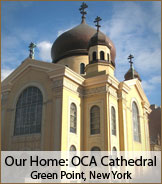
Established with the blessing of V. Rev. Fr. Wiaczeslaw, Rector of Orthodox Christian Cathedral of the Transfiguration of Our Lord (NY). |